Super Mario Labyrinth Board Game Review: Gameplay, Replayability & Verdict
The Super Mario Labyrinth board game is Ravensburger’s Mario-themed take on their classic Labyrinth series, and it works better than most video game board game adaptations. It takes the sliding tile mechanic that Labyrinth is known for, wraps it in familiar Nintendo characters and imagery, and produces something that genuinely functions as a family game rather than just a shelf piece for collectors.
This review covers how the game plays, who it’s suited for, what makes it worth buying, and what to temper your expectations on before purchasing.
What Is the Super Mario Labyrinth Board Game?
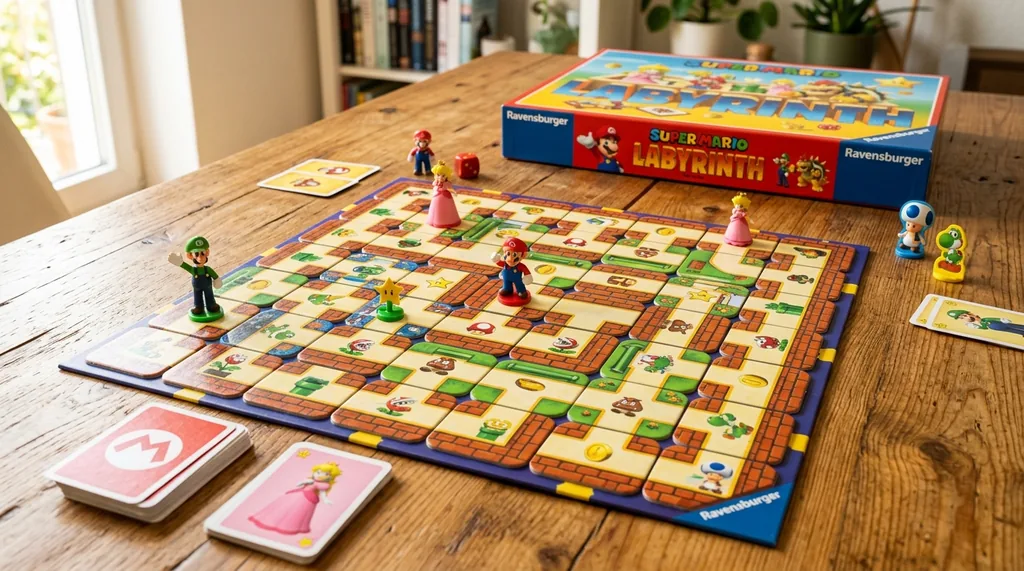
Super Mario Labyrinth is a 2–4 player board game published by Ravensburger for players aged 7 and up. It adapts the classic Labyrinth tile-sliding mechanic into the world of Super Mario, featuring characters like Mario, Luigi, Donkey Kong, and Princess Peach. Players take turns sliding maze tiles to reshape pathways and move their piece through the labyrinth, racing to collect a set of secret character cards and return to their starting position. A typical game runs 20 to 45 minutes depending on player count and how competitive the session gets.
The game was designed for family play and deliberately keeps its rules accessible — the rulebook is clear enough that most 7-year-olds can follow it without adult explanation after the first game.
How the Gameplay Works
Labyrinth’s core mechanic is tile sliding. The board is made up of a grid of maze tiles, some fixed and some loose. On each turn, a player pushes one of the loose tiles into the grid from the outside edge, which shifts the entire row or column and pushes a tile out the other side. This constantly reconfigures the maze paths.
After sliding a tile, the active player moves their character piece along the newly formed paths, trying to reach their current objective card. Each player has a stack of secret character cards — Mario, Peach, Donkey Kong, Bowser, and others from the Mario universe — and must navigate the labyrinth to find each one in sequence. The first player to collect all their cards and return to their home position wins.
The strategic layer comes from anticipating how your tile push affects not just your own path, but your opponents’. You can deliberately disrupt someone else’s route to buy yourself time. This creates the friendly tactical rivalry that makes Labyrinth satisfying for mixed-age groups — adults can think several moves ahead while younger players can still win through observation and opportunism.
Replayability: Why No Two Games Are the Same
Replayability is one of Super Mario Labyrinth’s real strengths. The maze tiles shuffle into a different configuration at the start of each game, so the board layout is never identical. The character cards are also dealt randomly, meaning the order in which players need to find characters changes every session. Ravensburger designed the game with enough tile variation to keep the puzzle genuinely fresh across dozens of plays.
For families with younger children especially, the randomized setup means the game doesn’t become memorized and stale after a few months. Even adult players who have internalized the strategy will encounter new tactical puzzles in each session because the initial board state is always different.
Component Quality
Ravensburger’s production quality is consistently strong, and Super Mario Labyrinth is no exception. The maze tiles are sturdy cardstock with a finish that holds up to repeated sliding without warping. Character artwork uses the official Nintendo Mario art style, so it looks recognizably on-brand rather than like a licensed approximation. The playing pieces are plastic character figures, which are more tactile and appealing than the flat tokens found in cheaper family games.
Setup takes about 5 minutes once you’re familiar with the tile layout process, and the compact box means it stores easily compared to heavier games. Nothing about the components feels cheap or likely to break down quickly with regular use.
Who Should Buy It?
Super Mario Labyrinth is best suited for families with children between 7 and 12, and for Mario fans who want a board game that delivers on the theme. The mechanic is engaging enough to hold adult interest without being too complex for younger players. It works well as a gateway game — something that introduces kids to strategic thinking without overwhelming them with rules overhead.
Players who already own and enjoy the original Ravensburger Labyrinth will find this a thematic reskin with slightly updated aesthetics rather than a mechanical reinvention. If you’re buying it primarily for the Mario theme, that’s a reasonable reason — the components and artwork do justice to the license. For dedicated board game hobbyists looking for depth, there are more complex options in the tile-placement category, but that’s not the audience this game is designed for.
For more tabletop options in the entertainment and games space, our Blade Runner RPG review covers another film-licensed game that goes deeper on narrative play.
Pros and Cons
What works:
- Accessible rules that both children and adults can pick up quickly
- Randomized setup ensures genuine replayability
- Authentic Nintendo Mario artwork and character figures
- Short play time (20–45 min) fits family schedules
- Tactical depth rewards players who think ahead, without excluding younger players
- Strong Ravensburger component quality
What could be better:
- Largely a reskin of classic Labyrinth — doesn’t reinvent the mechanic
- Less engaging for players unfamiliar with the Mario franchise
- Heavier strategy players will find it thin once the mechanic is mastered
Frequently Asked Questions About Super Mario Labyrinth
What age range is Super Mario Labyrinth suitable for?
The game is rated for ages 7 and up, but children as young as 6 can often participate with a little guidance. The Mario theme helps younger children engage quickly, and the rules are simple enough that most 7-year-olds can play independently after one session.
How many players can play Super Mario Labyrinth?
The game supports 2 to 4 players. It works well across all player counts, though 3–4 players tends to produce more tactical interaction and competition than 2-player games, where the tile-disruption strategy has fewer targets.
How long does a typical game session last?
A session typically runs 20 to 45 minutes depending on the number of players and how strategically they approach their moves. Younger players tend to keep games shorter by moving quickly; more tactical players extend play time through deliberate tile manipulation.
Is the game suitable for children who haven’t played board games before?
Yes. The directions are clear, and the familiar Super Mario characters help new players engage with the objective immediately. The sliding tile mechanic is intuitive after one or two turns, making it a good first board game for children.
What is the main objective of Super Mario Labyrinth?
Each player receives a set of secret character cards — featuring Mario, Peach, Donkey Kong, Bowser, and others. The goal is to navigate the shifting labyrinth to collect all your assigned characters and return to your starting position before the other players do.