Jaws Board Game Review: Asymmetrical Gameplay, Components & Verdict
The Jaws board game turns one of cinema’s most iconic suspense films into a genuinely tense tabletop experience. Designed by Prospero Hall and published by Ravensburger, it splits players into two sides — one controlling the great white shark, the others playing as the crew from the film. The asymmetrical design is the game’s strongest feature, and it holds up well across multiple plays.
This review covers gameplay mechanics, component quality, what makes it work, and who it’s best suited for.
Overview: What Is the Jaws Board Game?
The Jaws board game is a 2–4 player asymmetrical strategy game designed by Prospero Hall and published by Ravensburger. Players recreate the events of the 1975 film across two connected acts. One player controls the shark, moving in secret while hunting swimmers. The remaining one to three players take on the roles of Brody, Hooper, and Quint, working cooperatively to track down and kill the shark. The game is rated for ages 12 and up, with a play time of roughly 60 minutes per game.
What sets it apart from most licensed board games is the genuine asymmetry. The shark player and the crew play completely different games with different rules, goals, and resources — and the outcome of Act 1 directly shapes Act 2.
Components and Production Quality
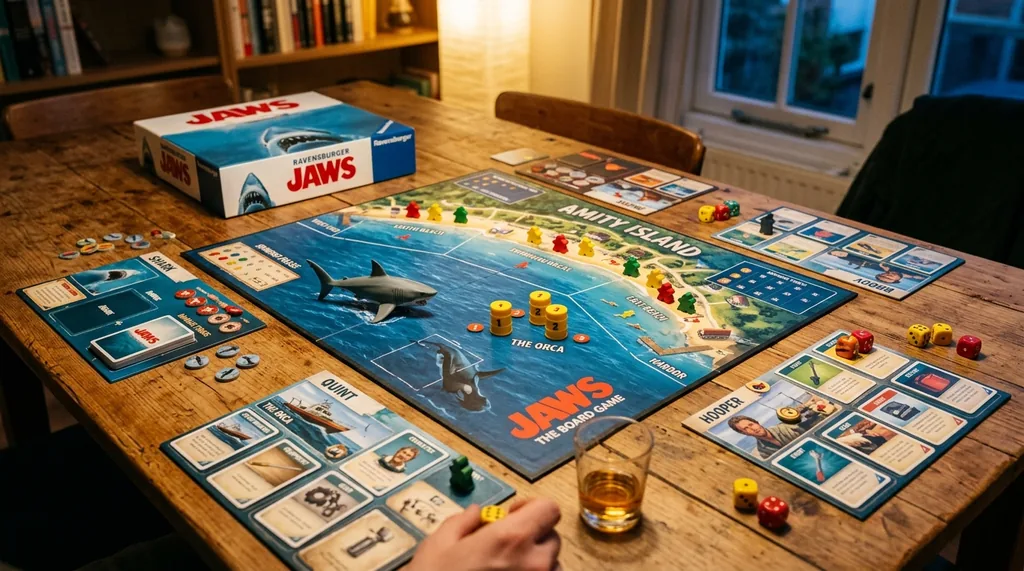
Ravensburger put real effort into the physical components. The game includes a double-sided board — one side showing Amity Island for Act 1, the other the open ocean around the Orca for Act 2. The artwork closely mirrors the film’s visual style, and the detail on both sides is noticeably above average for a licensed game at this price point.
Other components include character cards for Brody, Hooper, and Quint, each with unique abilities, plus a large shark miniature, barrel tokens, swimmer tokens, and a range of event and equipment cards. The shark miniature in particular is a nice tactile touch, though the real play happens through the hidden movement mechanism rather than the physical pieces themselves.
How the Gameplay Works
The game runs across two acts that mirror the structure of the film.
Act 1: Amity Island
In Act 1, the shark player moves secretly across the Amity Island board using a hidden movement system — tracking their position on a paper map rather than placing their piece on the board. Their goal is to eat as many swimmers as possible before the crew can locate them. The crew players, meanwhile, move around the island trying to block beaches, rescue swimmers, and gather enough intelligence to pinpoint the shark’s location. Each crew member has distinct abilities: Brody can close beaches, Hooper has specialized equipment, and Quint brings hunting expertise. Players have to coordinate carefully — the shark wins Act 1 by reaching a target number of eaten swimmers before being found.
Act 2: On the Orca
Act 2 shifts the action to the Orca, where the shark is now openly attacking the boat. The resources and barrels the crew managed to collect in Act 1 carry over here, giving good Act 1 performance a real payoff. The shark player works to destroy the Orca section by section, gradually reducing the space available to the crew. The crew must use their remaining resources to attach barrels to the shark and ultimately defeat it. This act plays out much faster than Act 1 and tends to be the more kinetic, tense half of the game.
Asymmetrical Design: Where Jaws Stands Out
Most licensed board games reduce the source material to a simple mechanic. Jaws doesn’t. The asymmetrical structure means the shark player and crew players are fundamentally playing different games with different decision trees. The shark operates with hidden information and patience. The crew operates cooperatively under time pressure. BoardGameGeek users rate the game’s complexity at around 2.17 out of 5 — accessible for newcomers but with enough tactical depth to reward experienced players.
The two-act structure is clever design. The result of Act 1 isn’t just narrative flavor — it has direct mechanical consequences for Act 2. A crew that struggled to collect barrels in Act 1 will have a harder time finishing the shark in Act 2. This makes the early game feel consequential rather than a warmup round.
Replayability and Difficulty Scaling
The game includes variable difficulty settings, which extends its lifespan well past the first few plays. The shark player can adjust their starting advantage, and the crew can modify which equipment cards are available. This makes it suitable for households with mixed experience levels. Experienced players who’ve mastered the hidden movement phase can increase the challenge, while newer players can lean on easier settings to get familiar with the mechanics.
Because one player has private information and the others are cooperating against them, the social dynamic shifts between plays depending on who controls the shark. The crew experience is cooperative; the shark experience is solo and stealthy. Both are engaging for different reasons, and switching roles between sessions keeps things fresh.
Who Should Buy the Jaws Board Game?
The Jaws board game is a strong pick for fans of the film who want a thematic board game experience, and equally good for tabletop players who enjoy asymmetrical games with hidden movement. It works best at 3–4 players, where the crew has full representation. At 2 players, one person controls the entire crew side, which works but loses some of the cooperative coordination. It’s not a great fit for players who dislike hidden information games or want something quick — 60 minutes is the average, and learning Act 1’s hidden movement system takes a session or two to get comfortable with.
If you enjoy other Ravensburger film-based games, the quality and design philosophy here is consistent. For more entertainment options in a similar vein, our roundup of free and legal movie streaming sites is worth a look if you want to revisit the film before your first game.
Jaws Board Game: Pros and Cons
What works:
- Genuine asymmetrical gameplay — both sides play very differently
- Two-act structure creates meaningful progression
- Strong component quality, especially the double-sided board
- Act 1 results carry over to Act 2, making every decision feel important
- Accessible rules with adjustable difficulty
- Captures the tension of the film without being a trivia or memory game
What could be better:
- Two-player experience is weaker than 3–4 players
- Act 1 hidden movement requires a paper tracking sheet, which some players find fiddly
- Non-fans of the film get less from the thematic elements
- Act 2 can feel short compared to Act 1
Frequently Asked Questions About the Jaws Board Game
How many players can play the Jaws board game?
The game supports 2 to 4 players. One player controls the shark throughout, while the remaining one to three players take on the roles of Brody, Hooper, and Quint as a cooperative crew. It plays best at 3 or 4 players, where all three crew characters are in play.
What is the recommended age for the Jaws board game?
Ravensburger recommends the game for players aged 12 and up. It involves card reading, hidden movement tracking, and strategic decision-making that can be challenging for younger players, though motivated children around 10–11 can typically handle it with adult guidance.
How long does a game of Jaws typically take?
A full game runs approximately 60 minutes from setup to finish. Act 2 tends to be faster than Act 1, so the total time varies depending on how quickly Act 1 resolves.
Is the Jaws board game difficult to learn?
The rules are clearly written and reasonably easy to pick up. BoardGameGeek rates the complexity at around 2.17 out of 5, placing it in the low-to-medium range. Most players are up and running within 15 minutes of reading the rulebook.
Can you play just one act of the Jaws board game?
You can play either act as a standalone experience, though the full game is designed to flow across both acts. Act 1’s outcome determines what resources the crew starts with in Act 2, so playing both gives the most complete experience. Playing Act 2 in isolation requires agreeing on a starting resource allocation beforehand.