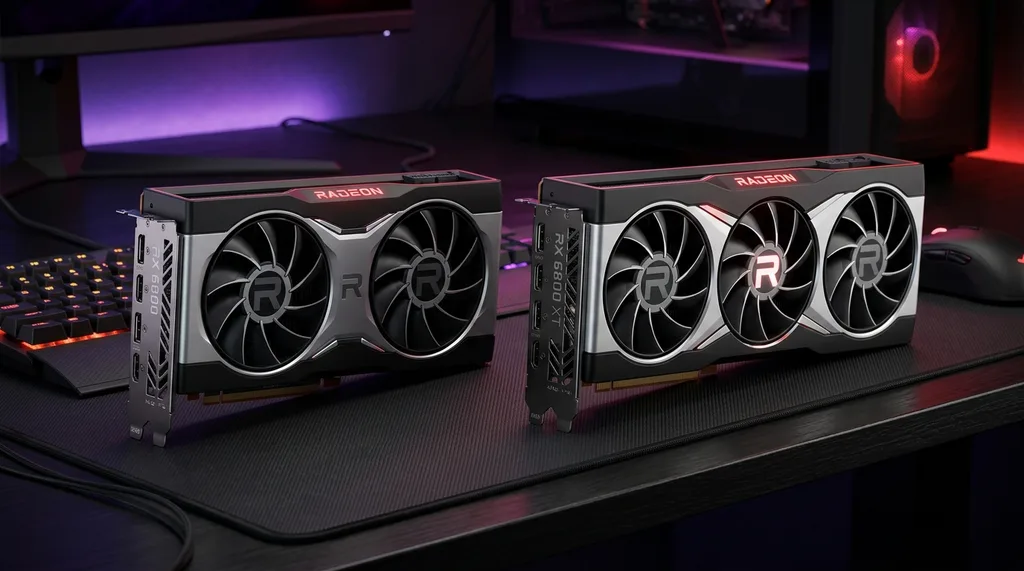
RX 6800 vs RX 6800 XT: Full Specs Comparison, Performance & Which to Buy
RX 6800 vs RX 6800 XT: Architecture and Core Specs
AMD launched the Radeon RX 6800 and RX 6800 XT in November 2020 as part of the RDNA 2 architecture refresh, positioning them directly against NVIDIA’s RTX 3070, RTX 3080, and RTX 3090. Both cards share the same Navi 21 GPU die with 26.8 billion transistors and the same 16GB of GDDR6 memory paired with 128MB of Infinity Cache — AMD’s on-chip cache that dramatically improves effective memory bandwidth for GPU-bound workloads. The key differences come down to compute units, clock speeds, power draw, and price.
Specs Comparison Table
| Spec | RX 6800 | RX 6800 XT |
|---|---|---|
| Architecture | RDNA 2 (Navi 21) | RDNA 2 (Navi 21) |
| Compute Units | 60 CU | 72 CU |
| Stream Processors | 3,840 | 4,608 |
| Game Clock | 1,815 MHz | 2,015 MHz |
| Boost Clock | 2,105 MHz | 2,250 MHz |
| VRAM | 16GB GDDR6 | 16GB GDDR6 |
| Memory Bandwidth | 512 GB/s | 512 GB/s |
| Infinity Cache | 128MB | 128MB |
| Transistors | 26.8 billion | 26.8 billion |
| TDP | 250W | 300W |
| Min. PSU | 650W | 750W |
| Compute Performance | 13.1 TFLOPS | 18.6 TFLOPS |
| Launch Price (MSRP) | ~$580 | ~$650 |
| Display Output | DisplayPort 1.4, HDMI 2.1 | DisplayPort 1.4, HDMI 2.1 |
Gaming Performance: Game by Game
The performance gap between the RX 6800 vs RX 6800 XT averages 12–15% in most modern games at 1440p and 4K. In some titles the gap is narrower; in others it widens considerably.
- 3DMark Timespy Extreme (4K): RX 6800 scores 6,334 vs RX 6800 XT at 7,514 — a 19% lead for the XT.
- Shadow of the Tomb Raider (4K Ultra): RX 6800 delivers 55 fps vs 96 fps on the XT — a 75% advantage, one of the largest gaps in the dataset.
- Hitman 2 (Ultra): RX 6800 hits 103 fps vs 123 fps on the XT — approximately 19% faster.
- Destiny 2 (4K/HDR Ultra): RX 6800 delivers 90–110 fps vs 100–120 fps on the XT — a smaller but consistent advantage.
- Dirt 5 (4K/1440p): RX 6800 XT leads by 23%, with 102 fps vs 71 fps on the base card.
According to Tom’s Hardware’s GPU hierarchy, both cards remain relevant for 1440p and 4K gaming workloads, with the RX 6800 XT holding a clear advantage in ray tracing and demanding 4K titles. For those interested in the display technology side of GPU performance, understanding how features like FreeSync technology interact with AMD GPUs matters just as much as raw frame rates — both RX 6800 cards fully support FreeSync Premium Pro.
Power Efficiency and Cooling
The RX 6800 runs at a 250W TDP vs the XT’s 300W, a 50W difference that has real-world implications. In practice, the RX 6800 runs cooler and quieter in most builds, while the RX 6800 XT’s additional power draw comes with notably louder fan behavior under sustained load — a commonly cited criticism. The RX 6800 also requires a 650W PSU minimum vs the XT’s 750W requirement, which may matter for users upgrading an existing system without replacing the power supply.
Which One Should You Buy?
The RX 6800 XT is the clear choice for 4K gaming. Its 72 compute units and higher clocks deliver the headroom needed for high-resolution, high-detail workloads. At launch, the ~$70 price difference made the XT a compelling value proposition: for less than 12% more money, you get 12–15% more performance on average and substantially more in certain titles. The tradeoff is a higher power draw and more fan noise.
The RX 6800 makes sense in budget-constrained builds or in systems where power efficiency and acoustics are priorities. Its 16GB VRAM and Infinity Cache give it strong longevity at 1440p, and it remains fully competitive against the RTX 3070 in rasterization workloads. For a broader view of where these cards fit in the GPU landscape, PCMag’s review of the RX 6800 XT provides detailed benchmarks across a wider game library and real-world use cases including video editing and content creation.
Frequently Asked Questions
Which is better for 4K gaming, the RX 6800 or RX 6800 XT?
The RX 6800 XT is the better choice for 4K. Its 72 Compute Units and higher boost clock of up to 2,250 MHz provide the additional headroom needed for high-resolution gaming, averaging 12–15% better performance than the RX 6800.
What is the actual performance gap between the two?
In most contemporary games at 1440p and 4K, the RX 6800 XT outperforms the RX 6800 by 12–15% on average, with the gap widening to 20%+ in particularly demanding titles like Shadow of the Tomb Raider and Dirt 5.
Do they use the same amount of VRAM?
Yes. Both the RX 6800 and RX 6800 XT use 16GB of GDDR6 memory paired with 128MB of Infinity Cache, giving both cards strong longevity for memory-demanding games and workloads.
Which one is more power-efficient?
The RX 6800 is more power-efficient with a 250W TDP, compared to the RX 6800 XT’s 300W. The base 6800 typically runs cooler and quieter in most builds under sustained load.
What power supply do I need for each card?
AMD recommends a 650W PSU for the RX 6800 and a 750W PSU for the RX 6800 XT to ensure system reliability under high load.