
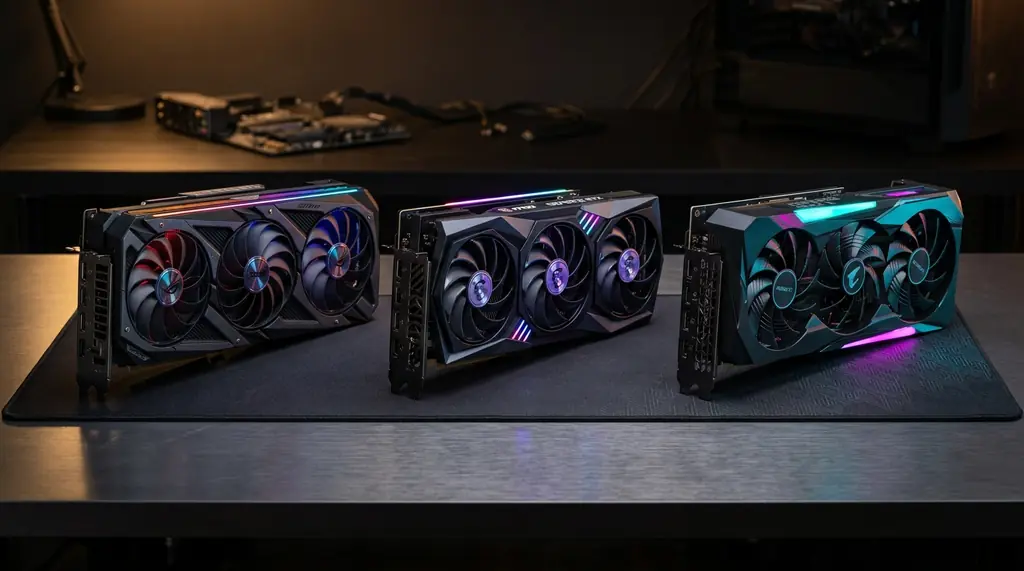
RTX 2070 vs RTX 2070 Super vs RTX 2080: Specs, Benchmarks, and Which to Buy
The RTX 2070, RTX 2070 Super, and RTX 2080 all came from Nvidia’s Turing generation, released between 2018 and 2019. They are no longer current-generation cards, but they remain capable options in the used GPU market — and the differences between them matter more than you might expect at first glance. This comparison breaks down the specs, real-world gaming performance, and which card makes sense depending on your resolution and budget.
The GeForce RTX 20 Series: Quick Background
Nvidia’s GeForce 20 series, built on the Turing microarchitecture, introduced hardware-accelerated real-time ray tracing to consumer graphics cards for the first time. According to the Wikipedia overview of the GeForce 20 series, the lineup launched in late 2018 with the RTX 2080 Ti, RTX 2080, and RTX 2070, followed by Super refreshes in mid-2019 that significantly improved the value proposition at the mid-range and upper-mid-range.
The Steam Hardware Survey has consistently shown that the RTX 20 series holds a meaningful share of active gaming systems globally — these cards remain genuinely relevant for 1080p and 1440p gaming in 2026, especially when purchased used at significantly reduced prices compared to their launch costs.
Core Specs Comparison
Here is a side-by-side look at the key technical specifications for all three cards:
| Specification | RTX 2070 | RTX 2070 Super | RTX 2080 |
|---|---|---|---|
| Architecture | Turing (TU106) | Turing (TU104) | Turing (TU104) |
| CUDA Cores | 2,304 | 2,560 | 2,944 |
| Transistors | 10.8 billion | 13.6 billion | 13.6 billion |
| VRAM | 8GB GDDR6 | 8GB GDDR6 | 8GB GDDR6 |
| Memory Bandwidth | 448 GB/s | 448 GB/s | 448 GB/s |
| Base Clock | 1,410 MHz | 1,605 MHz | 1,515 MHz |
| Boost Clock | 1,620 MHz | 1,770 MHz | 1,710 MHz |
| TDP | 175W | 215W | 215W |
| RT Cores | 36 | 40 | 46 |
| Tensor Cores | 288 | 320 | 368 |
The most significant architectural difference is the GPU die used. The RTX 2070 uses the smaller TU106 chip, while both the RTX 2070 Super and RTX 2080 use the larger TU104 die. This is not a minor distinction — the TU104 chip gives the 2070 Super substantially more shader processors, RT cores, and tensor cores than the base 2070, at a clock speed advantage to boot. Full spec details are documented on TechPowerUp’s GPU database.
Gaming Performance: 1080p, 1440p, and 4K
Benchmark performance across popular game titles tells a clearer story than raw specs. The numbers below reflect typical average frame rates at maximum or near-maximum quality settings:
1080p Performance
At 1080p, all three cards deliver well above 60 fps in virtually every modern game. The RTX 2070 averages around 100–110 fps in graphically demanding titles. The RTX 2070 Super adds approximately 10–12% on top of that. The RTX 2080 pushes a further 10–15% above the 2070 Super. At this resolution, the RTX 2070 alone is more GPU than most 1080p gaming setups need — the extra performance from the Super and 2080 is largely wasted if 1080p is your ceiling.
1440p Performance
This is where the card choice becomes meaningful. The RTX 2070 delivers playable 1440p performance in most titles but drops below 60 fps in the most demanding games at maximum settings. The RTX 2070 Super holds up considerably better, delivering 60+ fps in the vast majority of 2026 titles at 1440p/high settings. The RTX 2080 extends that further and handles ultra settings more consistently. If 1440p is your target resolution, the 2070 Super is the minimum comfortable choice; the 2080 provides better headroom.
In Battlefield V, the RTX 2070 averaged around 67 fps at 1440p while the RTX 2070 Super reached approximately 74 fps. In Metro Exodus — one of the more demanding ray-tracing titles of that era — the gap widened to 61 fps (2070) versus 69 fps (2070 Super).
4K Performance
Neither the RTX 2070 nor the RTX 2070 Super were designed as 4K cards, and both struggle to maintain consistent 60 fps at 4K ultra settings in demanding titles. The RTX 2080 handles 4K better than either, but even it falls short of delivering consistently smooth high-refresh 4K gaming. For 4K gaming in 2026, the RTX 30 or RTX 40 series is the more appropriate choice. These three Turing cards are 1080p-to-1440p GPUs.
RTX 2070 vs RTX 2070 Super: Is the Upgrade Worth It?
The RTX 2070 Super provides approximately 10–16% better performance than the base RTX 2070 depending on the workload. Importantly, it does this using the TU104 chip — the same die used in the RTX 2080 — rather than the TU106 chip in the standard 2070. This means the 2070 Super scales better when overclocked, often matching or exceeding stock RTX 2080 performance with even modest overclocking.
If you are buying used in 2026 and find a 2070 Super for a small premium over a base 2070, the Super is worth it. The architecture is meaningfully different, not just a clock speed bump.
RTX 2070 Super vs RTX 2080: The Value Calculation
At launch, the RTX 2080 was priced significantly above the RTX 2070 Super despite delivering only 10–15% more performance. That value gap made the 2070 Super one of the better-received GPU releases of the Turing generation. On the used market in 2026, the price difference between a 2070 Super and a 2080 has narrowed considerably — check current prices before assuming a large gap exists.
If you find a used RTX 2080 for a small premium over a 2070 Super, it is worth the extra money for the additional 1440p headroom and meaningfully better 4K performance. If the gap is more than 20–25% higher, the 2070 Super’s performance-per-dollar advantage is difficult to justify paying through. Also consider our comparison of the RX 6800 vs RX 6800 XT if AMD options are on the table — these are a generation newer and often competitive in the same used price range.
Which Card Should You Buy in 2026?
The right choice depends on your resolution target and how much you want to spend on a used card:
- 1080p gaming: The base RTX 2070 is more than sufficient and is the cheapest entry into the Turing RTX ecosystem. High frame rate 1080p gaming is comfortable on this card
- 1440p gaming: The RTX 2070 Super is the minimum comfortable recommendation at 1440p. It delivers consistent high-settings performance in most titles and overclocks well given its TU104 die
- 1440p at high refresh rates or near-4K: The RTX 2080 is the better choice here. Its additional RT cores and higher CUDA count give it meaningfully more headroom in demanding scenarios
- 4K gaming: None of these three cards are the right answer for 4K in 2026. Look at RTX 3080 or RTX 4070 territory instead
One more consideration: DLSS (Deep Learning Super Sampling) is available on all three cards and can meaningfully extend their effective performance by rendering at a lower resolution and upscaling. For demanding titles at 1440p, enabling DLSS can recover a significant portion of frame rate headroom on both the 2070 and 2070 Super. Check the Steam Hardware Survey for current data on how widespread RTX 20 series adoption remains among active gamers.
Frequently Asked Questions About the RTX 2070, 2070 Super, and RTX 2080
Is the RTX 2070 Super better than the RTX 2080?
The RTX 2080 is faster, typically by 10–15% depending on the game and resolution. However, the RTX 2070 Super is widely considered to offer better value — it delivers approximately 90–95% of the RTX 2080’s performance at a lower price, particularly when purchased used. With an overclock, the 2070 Super can match a stock RTX 2080 in many workloads because both cards share the same TU104 GPU die.
How much faster is the RTX 2070 Super than the base RTX 2070?
The RTX 2070 Super is approximately 10–16% faster than the standard RTX 2070, depending on the game. The performance gap is larger in RT-heavy workloads and at higher resolutions, because the 2070 Super uses the larger TU104 chip (same die as the RTX 2080) rather than the TU106 used in the base 2070. The architectural difference, not just clock speeds, explains why the gap is meaningful.
Can an overclocked RTX 2070 Super match the RTX 2080?
Yes, in many cases. Because the RTX 2070 Super and RTX 2080 use the same TU104 GPU die with the same memory configuration, an overclocked 2070 Super can match or slightly exceed a stock RTX 2080. The 2080 has more active CUDA cores (2,944 vs 2,560), so there is a ceiling to how far the 2070 Super can close the gap — but a modest overclock gets it within the margin of error in most titles.
Are the RTX 2070 and 2070 Super good for 1440p gaming in 2026?
The RTX 2070 is adequate at 1440p in most titles but will drop below 60 fps in the most demanding games at maximum settings. The RTX 2070 Super is the more comfortable choice at 1440p — it handles high settings consistently in the vast majority of games and pairs well with DLSS for demanding titles. For high-refresh-rate 1440p (144Hz+), the RTX 2080 provides better headroom.
Are these cards good for 4K gaming?
Not really, for demanding modern titles. The RTX 2080 is the strongest of the three at 4K and can hold 60 fps at high settings in some games, but struggles at ultra settings in the most demanding titles. The RTX 2070 and 2070 Super are not well-suited to 4K gaming in 2026. If 4K gaming is your target, the RTX 3080 or RTX 4070 are more appropriate used market options.