How Screen Printing Is Revolutionizing the Fashion Industry
Screen printing has been around for over a thousand years, but what it can do for a fashion brand in 2026 looks nothing like what artisans were doing with stencils and silk in ancient China. Today, it is the technique behind everything from limited-edition streetwear drops to stadium tour merchandise — and more recently, it has become a meaningful tool for independent designers who want control over exactly how their work looks on fabric. This article covers how the process actually works, why the fashion industry keeps coming back to it, and where sustainable screen printing fits into the picture.
What is screen printing?
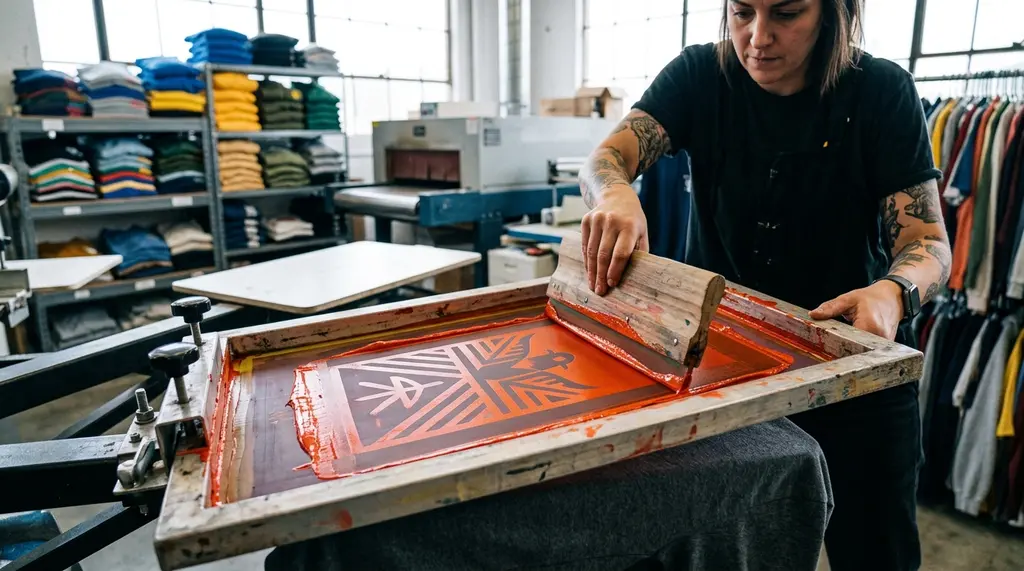
Screen printing is a method of applying ink to fabric by pushing it through a fine mesh screen stretched over a frame. A stencil — called a film positive or emulsion — blocks the areas where ink should not pass, so only the intended design transfers to the material beneath. Each color in a design requires a separate screen, which is why screen printing is highly cost-effective for large runs of a single design but less practical for small quantities or designs with dozens of color gradients.
The process is also known as silk screening, a holdover from when the mesh screens were made of silk rather than synthetic materials like polyester. Modern screens use finely woven polyester that allows for precise ink control and can withstand hundreds of print runs before degrading.
A brief history of screen printing in fashion
Screen printing traces its origins to China during the Song Dynasty (960–1279 CE), where artisans applied color to silk using woven mesh and cut stencils. The technique spread to Japan and later to Europe, where it was refined in the early 20th century for commercial textile production. By the 1960s, it had become the dominant method for producing graphic T-shirts, band merchandise, and political campaign apparel.
Andy Warhol is frequently cited as the artist who elevated screen printing to a fine art form — his Marilyn Monroe and Campbell’s Soup series were created using silkscreen techniques, and the pop art movement he helped define brought the process into conversations about design that had previously been reserved for oil painting. That cultural moment had a real effect on how fashion designers thought about graphic garments: if Warhol could make a soup can into art with screen printing, a designer could make a T-shirt into a statement.
Today, screen printing accounts for a significant share of custom apparel production worldwide. The T-shirt printing industry alone was valued at approximately $3.9 billion globally in 2023, with screen printing remaining the preferred method for volume orders above roughly 24 pieces per design.
Why fashion brands choose screen printing
Bold color and design accuracy
Screen printing produces colors that are noticeably more saturated and opaque than digital printing methods. When a brand needs a specific Pantone shade on a dark garment — a red that actually reads as red on black cotton, for instance — screen printing with plastisol inks is the reliable choice. Digital inkjet printing struggles with color vibrancy on dark fabrics; screen printing does not. This is why concert and festival merch, where exact brand colors matter, is almost always screen printed rather than digitally printed.
Cost efficiency for volume production
The economics of screen printing reward volume. Setup costs are relatively high — each screen costs money to produce, and a four-color design requires four separate screens — but once the screens are made, the per-unit cost drops sharply as quantity increases. For a run of 500 identical T-shirts, screen printing is typically 40–60% cheaper per unit than direct-to-garment (DTG) digital printing. For a run of 50, the math flips. This is why screen printing dominates mass production while DTG has taken the custom one-off market.
Durability on fabric
Screen-printed designs, particularly those using plastisol inks, can outlast the garment itself. Plastisol sits on top of the fabric rather than soaking in, creating a layer that resists cracking and fading through hundreds of wash cycles when applied and cured correctly. Water-based and discharge inks, which penetrate the fabric fibers, produce a softer hand feel but require more careful application and curing conditions. Both methods significantly outperform heat transfer vinyl in long-term durability.
Versatility across materials
Screen printing works on cotton, polyester, nylon, canvas, denim, and most other flat textile surfaces. This makes it useful far beyond the standard T-shirt: hoodies, tote bags, hats, denim jackets, and canvas sneakers all serve as regular substrates in the fashion industry. The main limitation is highly textured or stretch-dominant fabrics, where the ink layer can crack as the material deforms.
Sustainable screen printing: eco-friendly inks and practices
Conventional screen printing has an environmental liability: plastisol inks are PVC-based and contain phthalate softeners that are not biodegradable. When print shops wash uncured plastisol off screens, it enters wastewater systems unless properly intercepted. Responsible shops use reclaim systems and ink trap filtration, but not all do.
The industry response has been a steady shift toward water-based and discharge inks. Water-based inks use significantly less solvent, produce lower VOC emissions, and result in garments that feel more like the original fabric because the ink bonds with the fibers rather than sitting on top. Discharge inks go one step further — they chemically strip the dye from fabric in the design area and replace it with a new color, producing ultra-soft prints with no hand feel at all. Both alternatives have lower environmental impact than conventional plastisol.
Brands focused on sustainability, including several in the ethical fashion space, now specify water-based or discharge printing as a standard requirement for their apparel. Our overview of eco-friendly fashion practices covers how screen printing fits within a broader sustainable production approach.
Screen printing’s role in streetwear and indie fashion
The explosion of streetwear as a global fashion category is directly linked to screen printing’s accessibility. Supreme, Palace, and Off-White built their early brand identities through screen-printed graphics — bold logos and art-influenced designs that could be produced in small drops, generating scarcity and demand simultaneously. The low minimum order quantities at local print shops (often as few as 12 pieces) mean that an independent designer can test a graphic concept without a large capital commitment.
This dynamic has had a democratizing effect on fashion. Designers who cannot afford sample production with cut-and-sew factories can still produce a polished physical product through screen printing on blank wholesale garments. Platforms like Printful and Printify have automated this further, offering on-demand screen printing fulfillment — though true screen printing at that scale is typically replaced by DTG for very small quantities. The creative model, however, traces directly back to what screen printing made possible.
Screen printing vs. other clothing print methods
| Method | Best for | Color range | Durability | Minimum quantity |
|---|---|---|---|---|
| Screen printing | Volume runs, bold graphics | Spot colors (each screen = 1 color) | Very high | Typically 24–50 pieces |
| Direct-to-garment (DTG) | Complex full-color images, small runs | Full color / photographic | Moderate | 1 piece |
| Heat transfer vinyl (HTV) | Names, numbers, simple shapes | Spot colors | Moderate | 1 piece |
| Sublimation | Polyester fabrics, all-over prints | Full color | Very high | 1 piece |
| Embroidery | Hats, polos, structured fabrics | Thread colors (limited) | Excellent | Typically 12 pieces |
How to use screen printing for your fashion brand
Starting with screen printing is more accessible than it might appear. Local print shops in most cities offer contract screen printing, and national online fulfillment services handle everything from artwork prep to shipping. The practical steps:
- Prepare vector artwork. Screen printing requires artwork with separated color layers. Raster images with gradients and transparency need to be converted — most shops offer art prep services for a fee, or you can work with a graphic designer experienced in print production.
- Choose your substrate. The garment or fabric carries the print. 100% cotton takes water-based and discharge inks exceptionally well; polyester blends work better with plastisol. Ring-spun cotton produces a smoother print surface than open-end cotton.
- Decide on ink type. Plastisol for maximum color opacity and durability on light and dark fabrics; water-based for soft hand feel and lower environmental impact; discharge for ultra-premium softness on dyeable fabrics.
- Request a print strike-off. Before committing to a full run, ask for a printed sample. Color can shift between your monitor and the cured ink on fabric, and a strike-off catches mismatches before they affect hundreds of units.
- Plan for scaling. The per-unit economics improve significantly above 100 pieces. If you are launching a product that has demand potential, pricing your test run at a smaller quantity but planning for a reorder is more cost-effective than ordering speculatively large.
Frequently asked questions about screen printing in fashion
What is screen printing in fashion?
Screen printing in fashion is the process of applying ink to garments and accessories by pushing it through a mesh screen treated with a stencil of the desired design. It is one of the oldest and most widely used commercial printing methods in the apparel industry, valued for producing vibrant, durable graphics at scale. Each color in the design requires a separate screen and separate pass through the press.
Is screen printing good for clothing brands?
Screen printing is particularly well-suited for clothing brands that need consistent quality across volume orders. It is the standard method for branded merchandise, retail-ready apparel, and event clothing. Brands printing fewer than 24 pieces per design typically find digital alternatives more cost-effective, while those producing 50 or more pieces benefit significantly from screen printing’s lower per-unit cost at volume.
What are the basic materials used in screen printing?
A standard screen printing setup requires a mesh screen (polyester), photo emulsion to create the stencil, a squeegee to push ink through the screen, ink appropriate to the substrate, and a curing device — typically a heat tunnel or flash dryer — to set the ink permanently. Commercial print shops also use an exposure unit to burn the emulsion and a washout booth to develop and reclaim screens.
How durable is screen printing on clothes?
When printed and cured correctly, screen-printed graphics are highly durable. Plastisol prints can survive 50 or more wash cycles without significant cracking or fading. Water-based prints that are properly cured are also durable, though they tend to soften slightly with repeated washing. The weakest point in screen-printed durability is typically the edges of the print — if the ink is applied too thick or the garment is washed inside-out, edge cracking can occur over time.
What is the difference between screen printing and digital printing for fashion?
Screen printing applies ink through a physical stencil screen and produces colors that are opaque and vibrant, especially on dark fabrics. Digital printing (DTG) sprays ink directly onto the garment like an inkjet printer and handles photographic full-color images well, but typically produces less vibrant results on dark fabrics without a white base layer. Screen printing excels at volume production and bold graphics; digital printing excels at small quantities and complex photographic artwork.