
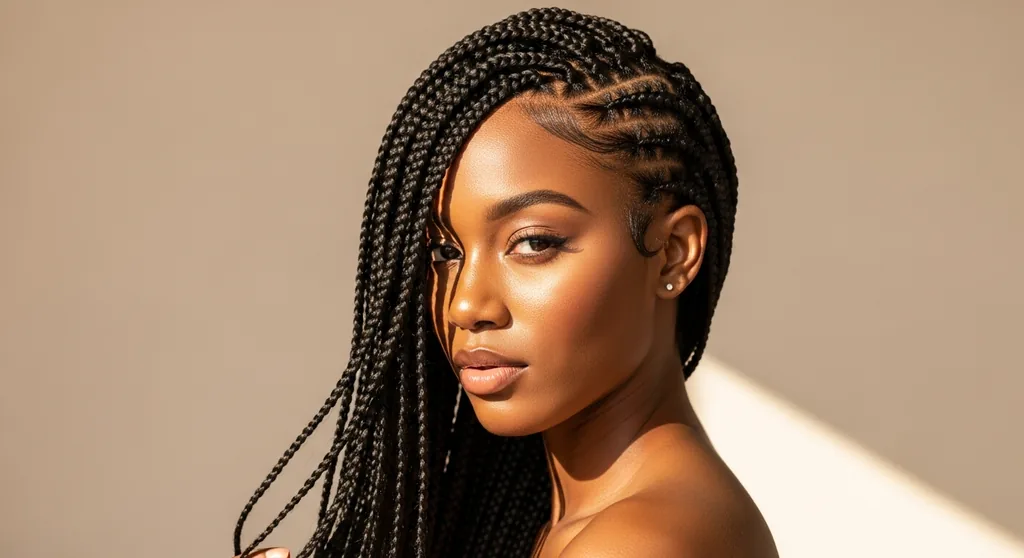
Your Complete Guide to Knotless Braids: Cost, Care and Everything In Between
Knotless braids are a protective hairstyle installed without the traditional tight knot at the root — the primary source of tension and scalp damage in conventional box braids. They start with your own natural hair and gradually feed in extensions as you braid down, distributing weight evenly rather than concentrating it at the scalp.
Kamilah — better known as Ms. Hair and Humor, the self-declared “Queen of Knotless Braids” — doesn’t mince words: if you’re thinking about getting knotless braids, welcome to the future. Low tension, lightweight, easy to maintain. For anyone who’s ever left a salon with a pounding headache and sore edges, the premise alone sounds too good to be true.
It’s not. But the appeal goes beyond comfort. “It erases years of trauma that Black women have shared while getting braid styles,” she says. “I’ve personally seen folks go through a range of emotions throughout a knotless braid experience. And I hope more women could understand that getting braids doesn’t have to hurt.”
Susan Oludele, owner of a Brooklyn braiding salon and founder of a cosmetology academy created specifically to address the lack of education around Black hair, agrees. “Box braids and protective styles are meant to safeguard your hair, not destroy it.” Knotless braids sit more naturally on the head, distribute weight better, and look seamless from root to end — no ridge at the scalp giving away where the extension starts.
What actually makes them knotless?
Knotless braids eliminate the anchor knot used in traditional box braids. Traditional box braids start by knotting extensions directly into your hair at the root — that knot is where tension concentrates, causing pressure on the scalp and hairline. With knotless braids, you start with your natural hair and gradually feed in extensions as you braid down, so there is no sudden pull at the root.
The result is a real reduction in traction alopecia risk — a type of hair loss caused by sustained tension at the root, as noted by the American Academy of Dermatology. “When you look at knotless box braids, you can’t tell where the hair starts or finishes,” Oludele explains. “They’re very seamless from the roots.” Whatever hair trend you’re chasing, knotless braids can accommodate any style you want.
Knotless vs. traditional box braids
| Feature | Knotless Braids | Traditional Box Braids |
|---|---|---|
| Installation method | Natural hair fed in gradually | Extensions knotted at root |
| Scalp tension | Low | High |
| Pain during install | Minimal | Common |
| Traction alopecia risk | Lower | Higher |
| Appearance | Seamless from root | Visible knot at root |
| Cost | $160-$600+ | Generally lower |
| Install time | 4-12 hours | 3-8 hours (typically) |
| Best for | Scalp sensitivity, hair growth | Budget-conscious, faster install |
What do knotless braids cost?
Knotless braids cost between $160 and $600 or more, depending on length, thickness, stylist experience, and location. At Susan Oludele’s Brooklyn salon, they start at $250. Longer, thinner braids cost more because they require additional time and extension hair.
“You’re paying for no tension, for the extensions, and how they’re installed,” Oludele says. “All of that comes into perspective for your service.” The higher price compared to traditional box braids reflects the technique — not just the material.
How do you take care of knotless braids?
Caring for knotless braids follows the same fundamentals as any protective style: keep your scalp moisturized with a leave-in spray and oil, tie your hair back at night, and sleep on a silk pillowcase or wear a silk scarf. The key difference with knotless braids is that more of your natural hair is exposed than with traditional styles.
“Even though your hair is braided with the extensions, most of your hair is more revealed, so you want to take care by tying back your hair,” Oludele explains. Don’t assume the braids are doing all the work. Consistent scalp care throughout the wear period is what makes the protective style actually protective. If you’re also exploring other beauty routines, pairing them with a proper braid care regimen will give you the best results.
How long do knotless braids last?
Knotless braids last two to three months with proper maintenance. Oludele recommends returning to the salon at the one-to-two-month mark for a touch-up: cleaning up edges, redoing parts, and cleansing the scalp. That single maintenance visit extends the style by another month.
Ms. Hair and Humor advises a stricter timeline of six to eight weeks: “The longer the style is in, the longer clients tend to neglect their own hair.” Protective styles only work when they’re part of an actual routine. Stay on top of scalp buildup — don’t let it sit just because the braids are covering it. Never keep them in past ten weeks. After that point, hair matting becomes a serious risk.
Best knotless braid styles worth looking at
For style inspiration, both Susan Oludele and Ms. Hair and Humor maintain active Instagram profiles documenting their work. For variety across sizes, colors, and lengths, celebrity stylists @nikkinelms, @vernonfrancois, and @creativexhands are consistently strong references. The range of options — waist-length, shoulder-length, jumbo, micro, colored, natural — is wide enough that there is no wrong starting point.
Frequently asked questions about knotless braids
How long do knotless braids really last?
Four to eight weeks for most people. Smaller braids, well-maintained, can stretch to ten weeks. Jumbo styles start looking frizzy around week four. Do not keep them in past ten weeks as hair matting becomes a serious risk.
Are knotless braids actually better than traditional box braids?
For scalp comfort and a more natural look, knotless braids win. Traditional box braids are usually cheaper and faster to install. The choice depends on your priorities: comfort and aesthetics favor knotless; budget and installation speed favor traditional.
Can you wash your hair in knotless braids?
Yes — every two to three weeks. Use a diluted sulfate-free shampoo, focus on the scalp rather than scrubbing the braids themselves, and use a gentle technique to minimize frizz.
Do knotless braids cause hair damage or hair loss?
When installed correctly, knotless braids reduce the risk of traction alopecia compared to traditional box braids because they eliminate the tight knot at the root. Damage typically occurs when braids are left in past ten weeks or installed too tightly.
How long does knotless braid installation take?
Expect four to twelve hours depending on length and braid size. Medium-length braids typically take five to six hours. Plan for a full-day appointment.