
IoT Gateways and Sensors Explained: How They Work and Why They Matter
What is the Internet of Things?
The Internet of Things (IoT) is a network of physical objects embedded with sensors and software that communicate and exchange data with other devices and systems over the internet. A connected temperature sensor on a factory floor, a soil moisture monitor on a farm, and a smart thermostat in your home are all IoT devices. To understand where the future of IoT is heading, you first need to understand the two components that make it work: gateways and sensors.
What is an IoT gateway?
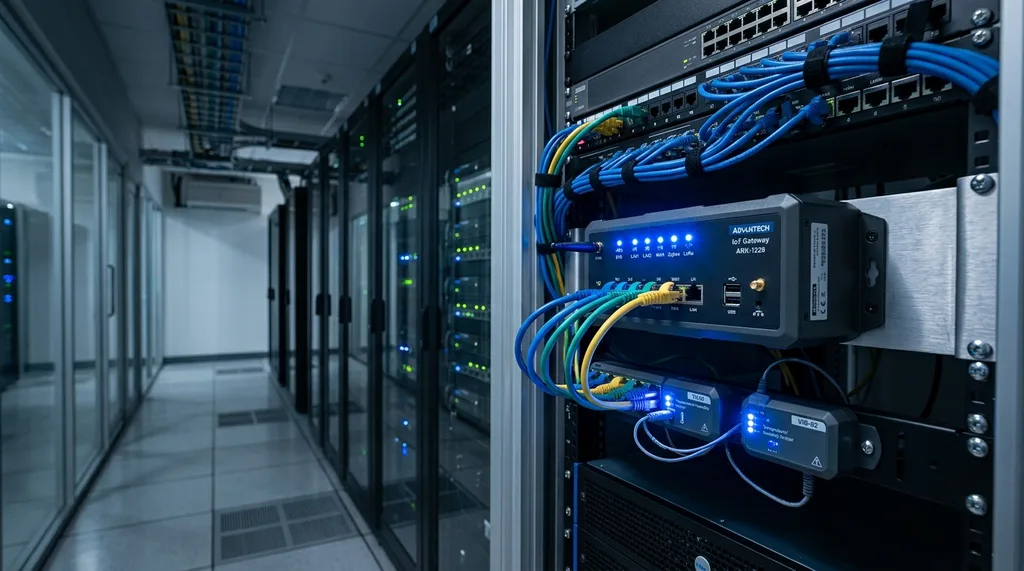
An IoT gateway is a communication system that bridges sensors, devices, and cloud platforms. Think of it as a smart router: where a standard router simply connects devices to the internet, an IoT gateway collects data from multiple sensors, pre-processes it at the edge, and forwards the relevant information to the cloud. It also receives instructions from the cloud and relays them back to connected devices.
According to IoT For All’s guide to IoT gateways, edge pre-processing is one of the most important functions a gateway performs. Rather than sending every raw data point to the cloud, the gateway filters and compresses the data first. This reduces bandwidth usage, lowers transmission costs, and cuts response times, which is especially important for sensors deployed in remote locations where connectivity is limited or expensive.
IoT gateway architecture
A modern IoT gateway has several distinct layers working together:
- Controller or CPU — handles processing speed and memory. The choice depends on the volume of data the gateway needs to manage.
- Operating system — typically Linux, Java, or RTOS, selected based on the application requirements.
- Hardware abstraction layer — separates the software from the underlying hardware, making it easier to update software without changing physical components.
- Sensor and actuator drivers — provide the interface between the gateway and the connected sensors.
- Cloud connectivity layer — manages the connection to cloud platforms via GPRS, 3G, 4G, or 5G modems.
- Security layer — enforces encryption to protect data in transit and safeguard devices against unauthorized access.
Most IoT gateways are deployed in locations with hardwired power and Ethernet access. For areas without power infrastructure, Power over Ethernet (PoE) variants deliver both data and electrical power through a single cable.
Types of IoT sensors
Sensors are the data collection points of any IoT system. They detect physical world conditions and convert them into electrical signals that the gateway can process. Here are the most common types:
Temperature sensors
Temperature sensors detect air or surface temperature and convert it into electrical signals. Manufacturing plants use them to maintain safe operating temperatures for machinery. In agriculture, soil temperature sensors directly influence decisions about irrigation and planting schedules.
Pressure sensors
Pressure sensors monitor changes in liquid and gas pressure. When pressure drops outside a defined range, the sensor triggers an alert in the connected system. Common applications include leak detection in pipelines, hydraulic system monitoring, and HVAC pressure regulation.
Proximity sensors
Proximity sensors detect the presence or absence of nearby objects without physical contact. They use different technologies depending on the material being detected: inductive sensors identify metal objects, photoelectric sensors use light beams, and ultrasonic sensors use sound waves. Parking facilities at airports, stadiums, and retail centers use proximity sensors to show real-time space availability to drivers.
Humidity sensors
Humidity sensors measure water vapor levels in the atmosphere. HVAC systems use them to regulate indoor climate. Hospitals rely on them to maintain sterile environments. Meteorological stations use them for weather forecasting and climate monitoring.
Gas sensors
IoT gas sensors detect and monitor the concentration of specific gases in the air, including carbon monoxide, chlorine, ozone, hydrogen, and sulfur dioxide. Oil and mining industries use them for worker safety. Carbon dioxide detectors in residential buildings commonly rely on the same technology.
Water quality sensors
Water quality sensors measure multiple parameters simultaneously: pH levels, dissolved oxygen, electrical conductivity, chlorine and fluoride concentrations, and the presence of contaminants. Municipal water systems, aquaculture operations, and industrial wastewater treatment plants all depend on these sensors for continuous monitoring.
Infrared sensors
Infrared sensors detect changes in infrared radiation emitted by objects. Healthcare IoT applications use them to monitor blood flow and blood pressure non-invasively. Industrial applications use them for non-contact temperature measurement and motion detection.
IoT gateway vs router: key differences
| Feature | Standard Router | IoT Gateway |
|---|---|---|
| Primary function | Connect devices to internet via IP | Bridge sensors, devices, and cloud |
| Protocol support | TCP/IP, Wi-Fi, Ethernet | Zigbee, LoRaWAN, Modbus, RS485, MQTT, and more |
| Data processing | None (pass-through) | Edge pre-processing and filtering |
| Security | Basic firewall | End-to-end encryption, device authentication |
| Offline capability | No | Yes (local storage and LAN operation) |
| Typical use | Home and office networking | Industrial, agricultural, healthcare IoT |
Choosing an IoT gateway
When selecting a gateway for your IoT deployment, focus on three factors. First, connectivity: verify the gateway supports the communication protocols your sensors use (Zigbee, Bluetooth, RS485, LoRaWAN, etc.). Second, environment: if the gateway will be exposed to heat, vibration, dust, or moisture, you need an industrial-grade unit with an appropriate IP rating. Third, capacity: confirm the gateway can handle the number of sensor endpoints your deployment requires without performance degradation.
Businesses building IoT-enabled digital infrastructure often work alongside digital agencies like Adwiz Digital to integrate IoT data dashboards and monitoring tools into their broader technology stack and web presence.
Frequently asked questions
What is the difference between an IoT gateway and a router?
A router connects nearby devices to the internet using IP addresses. An IoT gateway goes further: it translates between multiple protocols (such as Zigbee, Modbus, or LoRaWAN), performs edge computing to pre-process data, and then transmits it to the cloud.
How do I choose the right IoT gateway?
Focus on three factors: connectivity (does it support your sensors’ protocols like Bluetooth or RS485?), environment (does it need an IP67 rating for outdoor or industrial use?), and capacity (how many sensor nodes does it need to handle simultaneously?).
Can an IoT gateway work without the internet?
Yes. Many gateways can operate on a local area network (LAN), store data locally, and sync to the cloud once connectivity is restored. This is especially useful in remote or underground environments.
What are the best communication protocols for long-range IoT sensors?
LoRaWAN and NB-IoT are the leading long-range protocols. LoRaWAN works best on private networks like large farms. NB-IoT is better suited for dense urban areas with strong cellular coverage.
Why are industrial IoT gateways more expensive than home hubs?
Industrial gateways use ruggedized hardware designed to withstand high temperatures, vibration, and electromagnetic interference that would damage consumer-grade devices. The Siemens SIMATIC series is a common example.