
Why Turkey Is the Top Choice for Deep Brain Stimulation Surgery
What Is Deep Brain Stimulation?
Deep brain stimulation (DBS) is a surgical procedure in which electrodes are implanted in specific areas of the brain to deliver controlled electrical pulses. These pulses regulate abnormal neural activity, making DBS one of the most effective treatments for movement and neurological disorders when medications stop working.
Doctors use DBS to treat Parkinson’s disease, essential tremor, dystonia, epilepsy, and obsessive-compulsive disorder (OCD). According to Johns Hopkins Medicine, over 200,000 patients worldwide have received DBS implants, with significant symptom improvement in 60–80% of appropriately selected patients.
How the DBS System Works
A DBS system has three components that work together to control abnormal brain signals:
- The electrode (lead): A thin wire inserted through a small opening in the skull and positioned at a precise brain location.
- The extension wire: An insulated wire running under the skin from the scalp, down the neck, and into the chest.
- The internal pulse generator (IPG): A programmable battery device implanted beneath the skin in the upper chest. It sends electrical pulses through the extension to the electrode.
After surgery, a neurologist programs the IPG wirelessly, adjusting stimulation frequency, pulse width, and amplitude until symptoms are optimally controlled.
Who Is a Good Candidate for DBS?
DBS is typically recommended for patients who have lived with a neurological condition for several years and no longer respond well to medication. Ideal candidates include:
- Parkinson’s patients who experience motor fluctuations, dyskinesia, or severe tremors despite optimal drug therapy
- Essential tremor patients whose tremors interfere with daily tasks and resist medication
- Dystonia patients with generalized or focal symptoms that cause significant disability
- OCD patients who have not improved after multiple medication trials and behavioral therapy
A comprehensive pre-surgical evaluation — including brain MRI, neuropsychological testing, and neurology review — is required to confirm eligibility.
Why Turkey for Deep Brain Stimulation?
Turkey has become one of the world’s leading destinations for DBS surgery, drawing patients from Europe, the Middle East, and Central Asia. Three factors drive this reputation: specialist neurosurgical teams, JCI-accredited facilities, and costs that are 60–75% lower than in the United States or Western Europe.
Cost is often the deciding factor. An all-inclusive DBS package in Turkey typically costs $17,000–$33,000, covering pre-op MRI, the surgical procedure, the neurostimulator hardware, hospital stay, and post-operative care. In the United States, the same procedure can exceed $90,000. For patients exploring medical tourism options worldwide, Turkey consistently ranks among the most cost-effective destinations for complex neurological surgery.
Quality is not sacrificed for that price difference. Several Turkish hospitals hold Joint Commission International (JCI) accreditation — the same standard applied to leading hospitals in the US. Turkish neurosurgeons trained in Europe and the US perform hundreds of DBS procedures annually, and wait times are far shorter than in most public health systems.
Leading Hospitals for DBS in Turkey
Several hospitals stand out for their neurological surgery programs:
- Anadolu Medical Center (Kocaeli): A Johns Hopkins Medicine International affiliate with a dedicated neuroscience department and experienced DBS surgical teams.
- Memorial Sisli Hospital (Istanbul): A JCI-accredited facility known for high-volume movement disorder surgery and multidisciplinary neurology care.
- Liv Hospital (Istanbul): Offers comprehensive neurological evaluation, intraoperative monitoring, and post-surgical neuromodulation programming.
- Hizmet Hospital: Well-regarded for its neurosurgery department and experienced in treating international patients seeking movement disorder surgery.
Most facilities offer full medical coordination — airport transfers, interpreter support, accommodation assistance, and follow-up programming consultations.
What to Expect During the Procedure
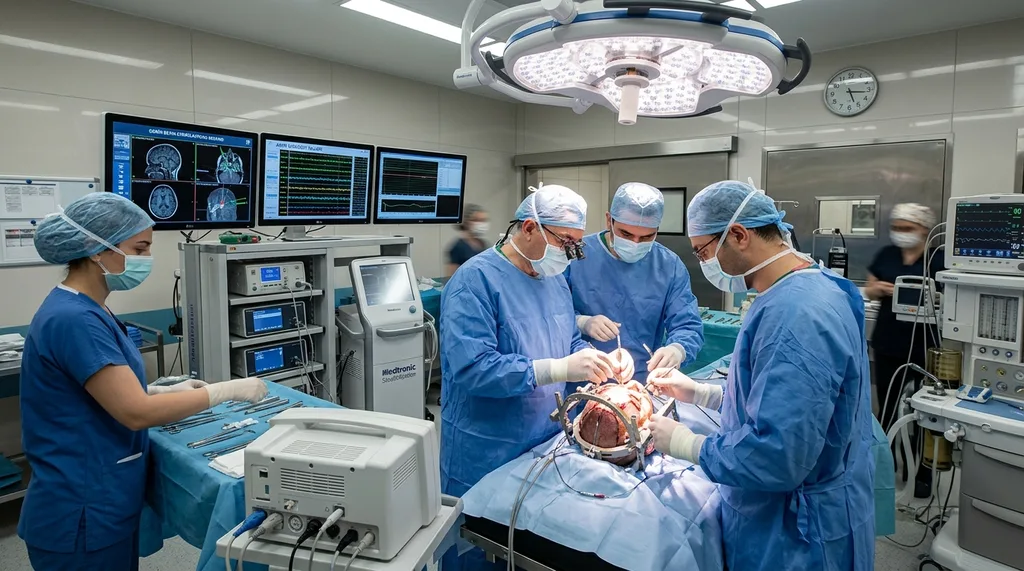
DBS surgery is most often performed while the patient is awake. This is intentional: patients provide real-time feedback during electrode placement so the team can confirm the optimal stimulation location. Local anesthesia manages discomfort.
The surgery typically happens in two stages. In the first stage, surgeons implant the electrode into the brain. In the second stage (usually the next day), they implant the IPG in the chest and connect the full system. Hospital stay typically lasts four to seven days, followed by an outpatient visit several weeks later to program and fine-tune the device.
According to a 2023 review published in Frontiers in Neurology, DBS reduces motor symptoms in Parkinson’s patients by an average of 40–60% on standard rating scales, with many patients also reducing their daily medication requirements significantly.
Frequently Asked Questions
Does DBS cure Parkinson’s disease?
No. DBS manages symptoms but does not halt or reverse the underlying disease. It effectively controls motor symptoms such as tremor, stiffness, and slow movement, and often allows patients to significantly reduce their medication doses — but the disease itself continues to progress.
Will I be awake during DBS surgery in Turkey?
Usually yes, at least during the electrode placement stage. Staying awake allows you to describe sensations and demonstrate movements so the surgical team can verify the electrode is in exactly the right position. Local anesthesia keeps the procedure tolerable throughout.
How much does DBS surgery cost in Turkey?
All-inclusive DBS packages in Turkey typically range from $17,000 to $33,000. This generally covers pre-surgical brain MRI, the neurostimulator hardware, the surgical procedure, hospital accommodation, and transport. The same procedure costs $70,000–$90,000 or more in the United States.
What is included in a Turkish DBS package?
Most packages include pre-operative MRI, DBS hardware (neurostimulator and leads), the surgery, hospital accommodation, VIP airport transfers, and in some cases hotel stays for accompanying family. Follow-up programming consultations are typically available at a fixed fee or included in premium packages.
How do I find a qualified DBS center in Turkey?
Look for JCI-accredited hospitals with dedicated neuroscience or movement disorder departments. Verify that the neurosurgeon has subspecialty training in functional neurosurgery and a documented caseload in DBS procedures. Most leading Turkish hospitals offer free pre-assessment video consultations for international patients.