Dungeons & Dragons Beginner’s Guide: Rules, Dice, and How to Start
Dungeons & Dragons has been around since 1974, but in the last decade it has crossed from niche hobby into mainstream culture — driven partly by streaming shows like Critical Role, partly by Stranger Things making D&D a plot device for an entire generation, and partly by a genuine shift in how people think about tabletop gaming. The 2023 film Dungeons & Dragons: Honor Among Thieves landed a 93% on Rotten Tomatoes and introduced a lot of people to the setting who had never rolled a die in their lives. If you are one of them and are wondering what the game actually involves, here is a clear-eyed introduction.
What is Dungeons & Dragons?
Dungeons & Dragons is a tabletop role-playing game in which players collaboratively create and navigate a shared fantasy story. One player takes the role of the Dungeon Master (DM), who designs and narrates the world, controls non-player characters, and arbitrates the rules. The other players each control a single character they have created — a wizard, a fighter, a rogue, a cleric — and describe what their character does in the situations the DM presents. The outcome of uncertain actions is determined by rolling dice.
There is no board in the traditional sense, no winning condition, and no fixed endpoint. A D&D campaign is a story that develops through play, and it can run for a single session or for years. The game’s current edition — 5th edition, published in 2014 — is by far the most widely played version in D&D’s history, and it is where the vast majority of new players start.
A brief history of Dungeons & Dragons
D&D was created by Gary Gygax and Dave Arneson and first published in 1974 by Tactical Studies Rules, Inc. (TSR). It grew out of miniature wargaming — specifically a Gygax-designed medieval combat system called Chainmail — and introduced the radical idea of players controlling individual characters rather than armies. The game sold surprisingly well and spawned an entire industry of tabletop RPGs.
The game went through several editions: the Basic Set, AD&D (1977), 2nd Edition (1989), 3rd Edition (2000), 4th Edition (2008), and the current 5th Edition (2014). Wizards of the Coast, which acquired D&D when it purchased TSR in 1997, published 5th Edition with a deliberate focus on accessibility — the rules are simpler than 3rd or 4th Edition, and the free basic rules are available as a download. As of 2023, Wizards of the Coast estimated that over 50 million people have played D&D, making it the most widely played tabletop RPG in the world.
The key roles: Dungeon Master and players
Every D&D game needs a Dungeon Master and at least one player, though 3-6 players is the typical range. The DM’s responsibilities are substantial: they design or select the adventure, describe what the players encounter, roleplay the non-player characters, and make judgment calls when the rules are unclear or incomplete. Being a DM well requires preparation, improvisation, and a certain comfort with being the one responsible for keeping things moving.
Players have a simpler role in some ways — they control one character, make decisions for that character, and roll dice when outcomes are uncertain. The best players contribute to the story by roleplaying their character’s personality and motivations, not just optimizing their combat statistics. D&D works best when the table agrees that collaborative storytelling matters more than any individual’s desire to “win.”
For players interested in other collaborative tabletop formats, our coverage of the Blade Runner RPG and the Alien RPG covers how different tabletop RPGs approach similar mechanics.
Character creation: what you decide before you play
Creating a character takes 30-60 minutes for a new player with help, or longer if you are doing it independently for the first time. The key decisions:
- Race. Elf, dwarf, human, halfling, dragonborn, gnome, half-orc, tiefling, and more. Race provides small statistical bonuses and some special abilities.
- Class. Fighter, wizard, rogue, cleric, ranger, paladin, barbarian, bard, druid, monk, sorcerer, or warlock. Class determines your character’s core abilities, what they can do in combat, and how they develop as they gain experience.
- Ability scores. Six statistics — Strength, Dexterity, Constitution, Intelligence, Wisdom, and Charisma — define your character’s fundamental capabilities. These are typically generated by rolling dice or using the 27-point buy system, which lets you allocate points without rolling.
- Background. A narrative origin (soldier, scholar, criminal, folk hero) that provides skills and gives roleplaying hooks.
You record all of this on a character sheet, which tracks your health, abilities, equipment, and spell slots across sessions. Free character sheets are available from the official D&D website.
How the dice work
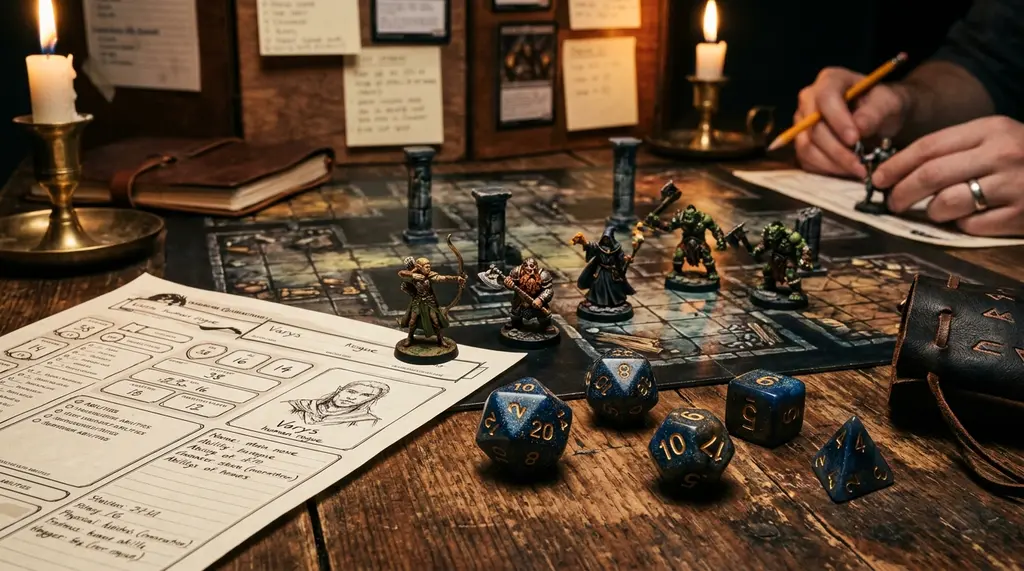
D&D uses a set of polyhedral dice: a 20-sided die (d20), a 12-sided die (d12), a 10-sided die (d10), an 8-sided die (d8), a 6-sided die (d6), and a 4-sided die (d4). The d20 is the most important — it determines the success or failure of most actions a character attempts.
When your character tries to do something with an uncertain outcome, the DM sets a Difficulty Class (DC) — a target number you need to meet or beat. You roll the d20, add your relevant ability modifier (a bonus or penalty derived from your stats), and compare the result to the DC. If you meet or exceed it, you succeed. If not, you fail — or partially succeed, depending on how the DM handles it.
The 27 rule, sometimes referenced in discussions of D&D, refers to the 27-point buy system for ability scores. Each of the six ability scores starts at 8, and you spend points from a 27-point budget to raise them. The maximum you can raise any score to is 15 (before racial bonuses). This system ensures all characters start with comparable overall power regardless of dice luck.
How combat works
D&D combat is turn-based. When a fight starts, everyone rolls for initiative — a d20 roll modified by Dexterity — which determines the order of turns. On your turn, you can generally move up to your movement speed and take one action (attack, cast a spell, help an ally, use an item, etc.) plus one bonus action if your class or a spell gives you one.
Attacks are resolved by rolling a d20 plus your attack modifier against the target’s Armor Class (AC). If your total meets or exceeds their AC, the attack hits, and you roll damage using the weapon’s die (d6 for a shortsword, d8 for a longsword, etc.). Spells follow similar logic, often requiring targets to make a saving throw against your spell save DC.
Combat in 5th Edition is designed to be faster and less tactical than previous editions. A typical combat encounter takes 20-45 minutes. Characters track Hit Points (HP); when HP reaches 0, the character falls unconscious. Three failed death saving throws at 0 HP means the character dies permanently — which is rare but possible.
How to get started playing D&D
- Download the free basic rules. Wizards of the Coast makes a substantial portion of the 5th Edition rules available as a free PDF. This is enough to play — you do not need to buy anything to start.
- Get a dice set. A standard seven-die polyhedral set costs $5-15 and is available at most game stores or online. Many digital tools also include virtual dice rolling, so physical dice are optional.
- Find a group. D&D requires other people. Options include: friends who play, local game stores that run Adventurers League organized play sessions, Reddit communities like r/lfg (looking for group), or virtual tabletop platforms like Roll20 and Foundry that support online play.
- Start small. The starter set (Lost Mine of Phandelver) is a purpose-built introductory adventure that includes pre-made characters, simplified rules, and a complete beginner-friendly campaign. It costs around $20 and is the most recommended starting point for new groups.
- Watch before playing. Shows like Critical Role (experienced voice actors playing D&D live) and Dimension 20 demonstrate how sessions actually play out and give new players a reference for what “good D&D” looks like.
Frequently asked questions about Dungeons & Dragons
How long does it take to learn Dungeons & Dragons?
Most players are functional in D&D after one or two sessions. The core mechanic — roll a d20, add a modifier, compare to a target number — takes minutes to understand. The broader rules (spells, class features, conditions, combat options) take longer and are typically learned gradually through play. You do not need to read the entire Player’s Handbook before your first session. Start with your class features and dice mechanics, and look up anything else as it comes up.
What is the best edition of D&D to start with?
5th Edition (5e) is the right starting point for nearly all new players. It has the largest player community, the most available resources, the most published adventures, and the most accessible rules in the game’s history. The free basic rules available from Wizards of the Coast cover everything a player needs to start at no cost.
Can D&D be played online?
Yes, and online play has grown significantly since 2020. Roll20 and Foundry VTT are the most popular virtual tabletop platforms — they provide digital maps, token tracking, dice rolling, and character sheets in one browser-based environment. Discord is commonly used for voice and video. Some groups use only text-based play in Discord servers without a virtual tabletop at all.
What is the 27-point buy system in D&D?
The 27-point buy is an optional method for generating ability scores. Instead of rolling dice (which produces random results that vary significantly between characters), players spend 27 points to increase their six ability scores from a base of 8. The point cost increases for higher scores — raising a score from 14 to 15 costs 2 points rather than 1. The system caps scores at 15 before racial bonuses. It produces more balanced, predictable characters than dice rolling.
What is the golden rule in D&D?
The golden rule of D&D, stated in the Dungeon Master’s Guide, is that the DM’s ruling takes precedence over the written rules. If a situation arises that the rules do not clearly cover, or if following a rule strictly would produce an unsatisfying outcome, the DM makes a call and the game continues. This is a deliberate design choice — D&D is a collaborative game, not a legal document, and the rules exist to serve the story rather than the reverse.